

Photoshop tutorial - Realistic chalk font/text
11 posts • Page 1 of 1
Photoshop tutorial - Realistic chalk font/text
There are fonts out there that pretend to look like chalkboard writing, but when it comes down to it, they just don't. In this Photoshop tutorial you'll learn how to create a realistic looking chalkboard text effect that's simple to do. Off we go...
Step 1: Get yourself a nice chalkboard image.where your text (or image) will go. I've picked the one below. The higher resolution the better, especially if you're printing. Shoot for 300 DPI in that case to get a photo-realistic chalk effect.
Step 2: Download the free font Kindergarten, or use some other scripty looking font that you have gathering dust. Remember, to install a font on a Windows machine, you can just go to your control panel, select "Fonts", and drag the font into the folder.
Step 3: With your chalkboard image open, select the text tool ("T"). Make sure the font you want is selected and type your text in a very slightly greyed tone.
Step 4: Now, duplicate your text layer by dragging and dropping it to the new layer icon in the Layers panel (shown below).
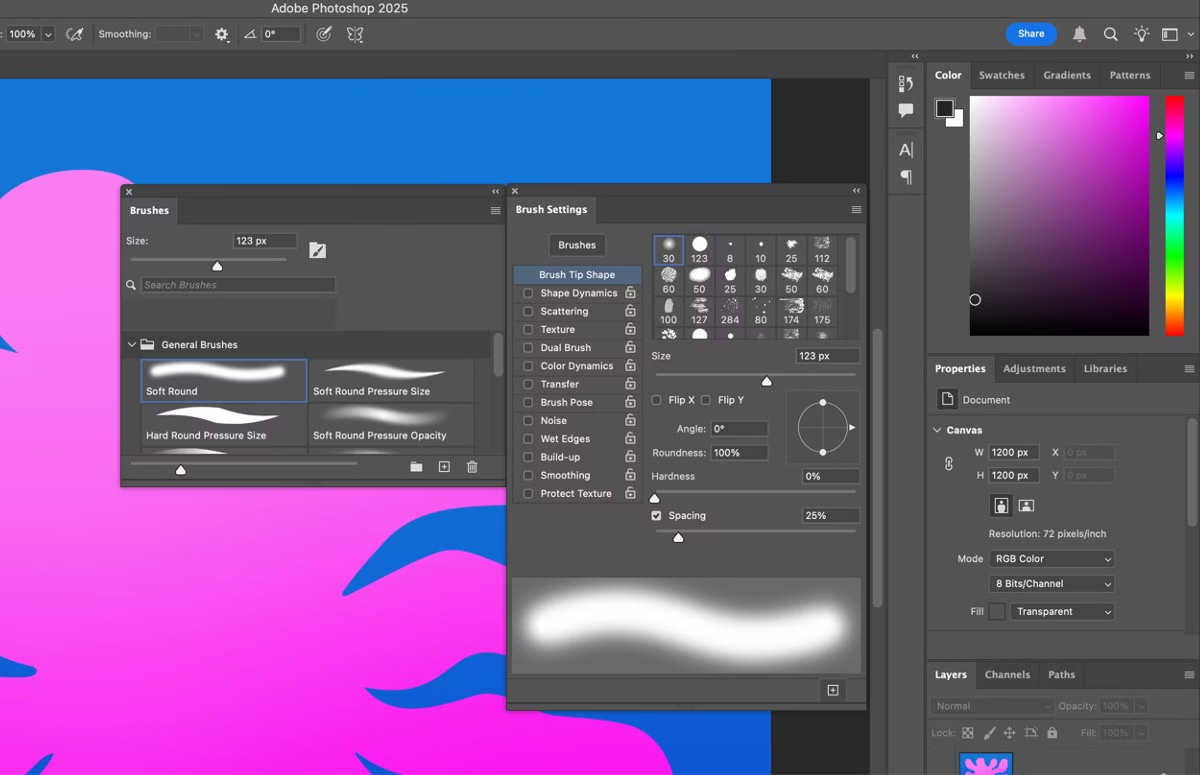
Step 5: Right-click the bottom text layer and hit "Rasterize Layer". Double-click this rasterized text layer to bring up the effects menu. (It helps if you hide the top text layer from view by clicking on the eye icon in the layers panel).
Step 6: With the effects panel up on this rasterized layer, click "Stroke" and set a 1 pixel, outside stroke in the same color as the chalkboard text. Set the blend mode to "Dissolve", and the opacity to 30%. You should get something that looks like this:
Step 7: Click "Pattern" and set the blend mode to "Dissolve". Almost any pattern will do. Play with the settings until you get something like this:
Step 7: Now go to LAYER > LAYER STYLE > CREATE LAYER. This will turn separate the effects layer from the type layer. Link the two in the layers panel, then click the little arrow in the upper right corner of the layers panel and select "Merge linked".
Step 8: Your "fuzzy" layer should look just like it did in step 6. Go to FILTER > GAUSSIAN BLUR and blur it will a radius of about 0.3 pixels or so. Make the top text layer visible (that you duplicated in step 4), make sure it's above the layer you've been working with, and set its blend mode to "Soft light". You should have something that looks like this:
There you have it. Once you've got the steps down this effect is pretty quick to recreate. Mess around with the smudge and soften tools to make the text look as if it was touched when writing it. Hope this tutorial's useful to you.
Step 1: Get yourself a nice chalkboard image.where your text (or image) will go. I've picked the one below. The higher resolution the better, especially if you're printing. Shoot for 300 DPI in that case to get a photo-realistic chalk effect.
Step 2: Download the free font Kindergarten, or use some other scripty looking font that you have gathering dust. Remember, to install a font on a Windows machine, you can just go to your control panel, select "Fonts", and drag the font into the folder.
Step 3: With your chalkboard image open, select the text tool ("T"). Make sure the font you want is selected and type your text in a very slightly greyed tone.
Step 4: Now, duplicate your text layer by dragging and dropping it to the new layer icon in the Layers panel (shown below).
Step 5: Right-click the bottom text layer and hit "Rasterize Layer". Double-click this rasterized text layer to bring up the effects menu. (It helps if you hide the top text layer from view by clicking on the eye icon in the layers panel).
Step 6: With the effects panel up on this rasterized layer, click "Stroke" and set a 1 pixel, outside stroke in the same color as the chalkboard text. Set the blend mode to "Dissolve", and the opacity to 30%. You should get something that looks like this:
Step 7: Click "Pattern" and set the blend mode to "Dissolve". Almost any pattern will do. Play with the settings until you get something like this:
Step 7: Now go to LAYER > LAYER STYLE > CREATE LAYER. This will turn separate the effects layer from the type layer. Link the two in the layers panel, then click the little arrow in the upper right corner of the layers panel and select "Merge linked".
Step 8: Your "fuzzy" layer should look just like it did in step 6. Go to FILTER > GAUSSIAN BLUR and blur it will a radius of about 0.3 pixels or so. Make the top text layer visible (that you duplicated in step 4), make sure it's above the layer you've been working with, and set its blend mode to "Soft light". You should have something that looks like this:
There you have it. Once you've got the steps down this effect is pretty quick to recreate. Mess around with the smudge and soften tools to make the text look as if it was touched when writing it. Hope this tutorial's useful to you.
BloodJelly... you are a God among Gods in my eyes. This has been EXACTLY what I've been looking for. Thank you very much!
"Hoka ni wo Nanimo Iranai, Anata ga ireba. Sora mo, Kumo mo, Machi mo, Hana Sae mo..."
As long as you are around, I need nothing. Not the sky, not the clouds, not this town, not even flowers...
-[Fumiko Orikasa, "Hoshi no Hate"]-
As long as you are around, I need nothing. Not the sky, not the clouds, not this town, not even flowers...
-[Fumiko Orikasa, "Hoshi no Hate"]-
Re: Photoshop tutorial - Realistic chalk font/text
This is an awesome tutorial. It works great with logos and other things as well that you want to give the appearance of chalk.
Thanks much!
Thanks much!
Re: Photoshop tutorial - Realistic chalk font/text
Awesome, I was searching for something like this. Perfect, i am going to use this for a T-Shirt I am designing. Visit the work on ThirdDesign.net
Thanks Again
RobertB
thirdDesign
http://www.flickr.com/thirddesign
Thanks Again
RobertB
thirdDesign
http://www.flickr.com/thirddesign
Re: Photoshop tutorial - Realistic chalk font/text
Glad you guys like it. Let us know when that T is out, Rob, I'd like to see it.
Re: Photoshop tutorial - Realistic chalk font/text
Wouldn't it be easier just to set up a camera in front of a chalkboard, and shoot a picture of it? 
By the way, how do you make a realistic chalkboard?
Re: Photoshop tutorial - Realistic chalk font/text
DrayeArt wrote:By the way, how do you make a realistic chalkboard?
Take a picture of it.
Re: Photoshop tutorial - Realistic chalk font/text
It's often amusing, once you start getting into diggyart, how you often try to recreate reality, when just using reality can be so much easier(and cheaper).
2 anecdotes-
At the beginning of this year, when I started getting into animating things, a buddy of mine told me that what I was doing was not animation. It was merely film. I had to explain to him how I had to pick each cel apart, restore or PS it, re-crop it for the angles I wanted, retint and filter it, and all the other stuff I learned on my own(no books or courses, simply trial and error)etc. etc. to make these little snippets of film. I may have worked harder on pre-existing film, than when I created something out of whole cloth. Regular animation seems very easy to me now(hopefully I wont get bored).
Another friend of mine(who happens to be a (very) fledgling film maker, wants to make low budget films, but can't find the locations in Florida. He wants to make a western, except nothing in Florida looks remotely like the old west. I told him he could recreate any scene he wants, right in his computer. All he needs is the actors to drop in where he needs them. He said something like "It can't be done!". I told him "What do you think Titanic was? Do you think they sunk a liner just for a 10 minute scene!?"
Bottom line with these 2 stories, is that we can sometimes overlook the obvious, when working with this stuff. As we can with traditional art, too!
2 anecdotes-
At the beginning of this year, when I started getting into animating things, a buddy of mine told me that what I was doing was not animation. It was merely film. I had to explain to him how I had to pick each cel apart, restore or PS it, re-crop it for the angles I wanted, retint and filter it, and all the other stuff I learned on my own(no books or courses, simply trial and error)etc. etc. to make these little snippets of film. I may have worked harder on pre-existing film, than when I created something out of whole cloth. Regular animation seems very easy to me now(hopefully I wont get bored).
Another friend of mine(who happens to be a (very) fledgling film maker, wants to make low budget films, but can't find the locations in Florida. He wants to make a western, except nothing in Florida looks remotely like the old west. I told him he could recreate any scene he wants, right in his computer. All he needs is the actors to drop in where he needs them. He said something like "It can't be done!". I told him "What do you think Titanic was? Do you think they sunk a liner just for a 10 minute scene!?"
Bottom line with these 2 stories, is that we can sometimes overlook the obvious, when working with this stuff. As we can with traditional art, too!
11 posts • Page 1 of 1
Who is online
Users browsing this forum: No registered users and 0 guests

Join us
Our features
Art websites