



3dflashworld
SOFTutorials: We found the missing piece
Partners links
Preparing the Outline
 
I used to CG trace my pictures, but I have found that that takes too long, and that it is easier just to use an inked sketch. Once you have decided what picture you want to color, retrace the image onto a clean piece of paper and carefully ink it.
It usually helps to use big paper and thin pens, so you can get a really crisp, thin outline. If you mess up the inking, you can clean it up with whiteout or by fixing it in Photoshop. Erase any extra pencil lines and get the inked outline as clean as possible. Scan the outline and load it into Photoshop. Make sure your outline is in RGB mode before you continue. To put your outline in RGB mode, go to the Image menu on the top bar, then Mode, and RGB Color. A lot of people like to keep the outline on the bottom of the picture, and then color on top using layers set to "Multiply". The major flaw in coloring this way is that you have no way to color the outline. Adding color to the outline can give your picture a nice touch. In order to do this, though, you have to make the outline transparent, which will allow you to color beneath it (just as if you put the outline on a sheet of transparency paper).
Before you do anything, though, adjust the brightness and contrast of your image until the white areas are pure white and the black lines are dark black, but not pixelly. If you aren't careful and adjust the contrast too much, you'll end up with a jagged outline, as in the picture to leftmost picture. You do not want an outline this jagged and ugly; you want it to be as smooth and crisp as possible, so be careful. You will also want to go over sketchy areas, such as the eye in this picture, and clean up the lines a little bit. I'm usually not patient enough to do this too often, though. Once you shrink down the image, flaws in your outline won't be as noticeable, anyway. 
Now, in order to make your
freshly cleaned outline
transparent, first select the entire
canvas. Copy the entire outline,
and paste it into a layer by itself
as shown to the left. You will
then have two copies of your
outline: the background layer,
and Layer 1. Delete the
background layer, and create a
new blank, pure white
background by going to the
Layers menu, then to New
Background.
Next, go to the
Channels menu on
the floating layers
window. Click the
"Load Channel as
Selection" button,
which is the
leftmost button
that looks like a
little dotted circle
on the bottom of
the menu. What
this does is select
all of the white
areas on a picture,
so you don't have
to use the magic
wand. Avoid
using the magic
wand at all costs!
It can make some
really sloppy
selections.
Anyway, after
hitting the "Load
Channel as
Selection" button,
all the white areas
should be
surrounded by
dashed lines.
Make sure that Layer 1 is selected, and not the background
layer, then hit delete. This will delete all white areas from
the picture, leaving only the black outline. Deselect the
image so that the dashed lines go away, leaving only the
outline. You'll notice that the outline is a little faded,
though. Don't worry, this is very easy to correct.

Set Layer 1 to
"Preserve
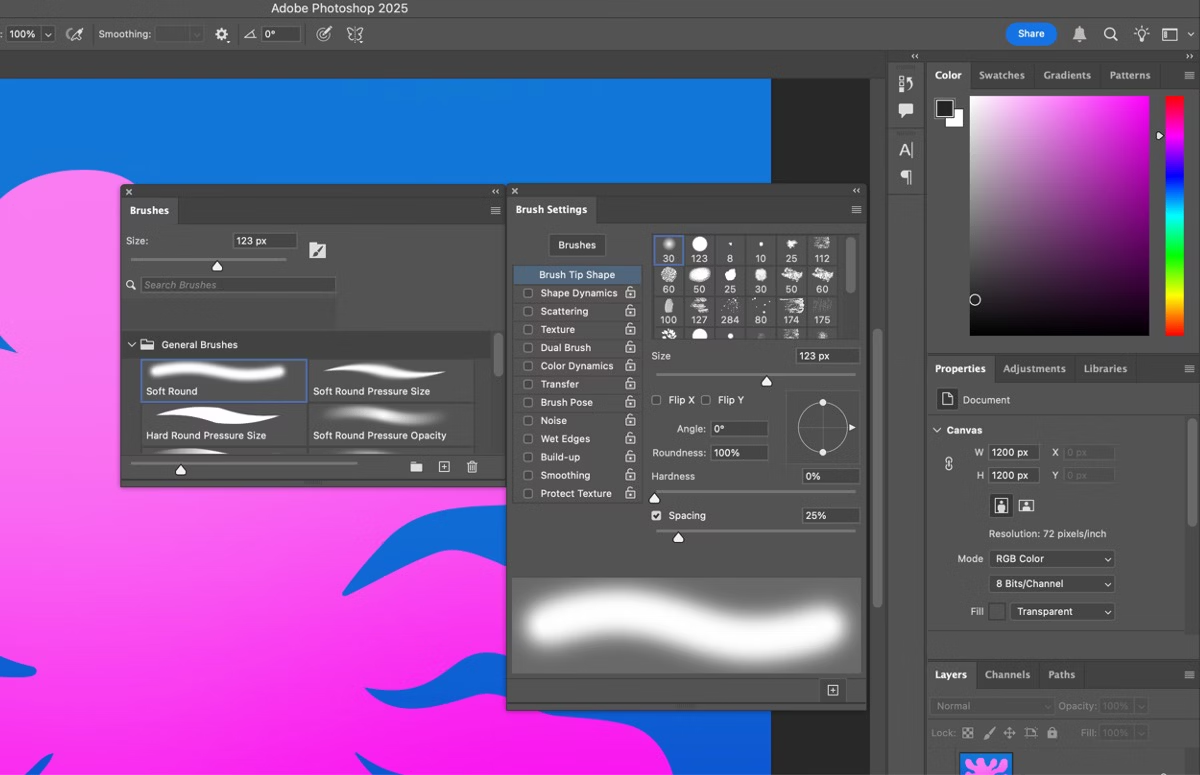
Transparency" by checking the box on the Layers menu, as shown at the left. This allows you to paint on top of the existing lines without coloring over them and messing them up. Its a very handy feature. Select a bi paintbrush and paint over the entire picture with pure black. The outline should be back to its former darkened self.There, now you have a clean, transparent outline ready to be colored underneath.
 
  Home | next page   
Copyright © 2007 DejanWebWorks
Photoshop Coloring Tutorials
G Source 
HOME 3D MODELS FLASH TUTORIALS 3D TUTORIALS PHOTOSHOP TUTORILAS 3D WALLPAPERS CONTACT
CYGAD's EarthLocations
Link Exchange
 
web metrics