


Tuesday, November 20, 2007

Designing Corporate Teaser Graphic, Part 2: Realistic Objects

Here we will continue the work on corporate teaser graphic started in the first part of this tutorial. Please take a look at the outcome once again:

teaser-tutorial-1-1.jpg

In today’s tutorial we will add the phone card with a properly rendered shadow.

Step 1

Take a phone card scan. Mine supposedly comes from a client, but for our educational purposes we can take this: phone-card.psd.zip (I have found this using Google Images):

teaser-tutorial-2-1.jpg

We need to cut this out of the white background, so let’s do it. Grab the Rounded Rectangle Tool (keyboard U), and make a couple of test rectangles to find out what the corner radius is. I made a couple with smaller and larger radius’ and found out that a radius of 20px works best:

Rounded Rectangle Masking Rounded Rectangle Masking Rounded Rectangle Masking

Note, that some yellow still visible on the sides – but that’s OK, now we can be sure that this outline will be clean and straight.

Pick the Path Selection Tool (keyboard A), and select the rectangle, then press Cmd+C. In the Layers palette select the card layer and paste the vector shape Cmd+V. Now go to the main menu Layer → Vector Mask → Current Path. The phone card image is now cut out from the background with it’s outline as clean as possible:

Rounded Rectangle Masking teaser-tutorial-2-6.jpg

Now duplicate the masked card layer into our main document (refer to the previous tutorial how to do that).

Step 2

Now we will rotate and place the card according to our composition.

Place the card inside the teaser group if not already. You will see that our vector mask applied to the group cuts off all unnecessary leftovers nicely:

teaser-tutorial-2-7.jpg

Now press Cmd+T and start transforming the card. When you place your cursor near the corner handles, it turns into a small rotation arrow, so you can rotate the image by dragging in different directions. Also, don’t forget to use the Shift key when resizing the image – this ensures that your image has fixed aspect ratio, i.e. it’s not distorted or stretched in any way. Place the card like shown on the following picture:

teaser-tutorial-2-8.jpg

Finally hit Cmd+Enter to finish transformation.

Step 3

Our card looks somewhat too plain, so we will add a little gradient overlay to it.

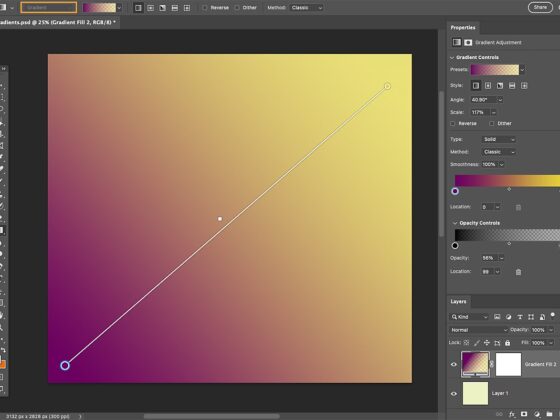
Switch to Gradient Tool (keyboard G), and set your gradient like this (both sides black #000000, and one side 100% transparent):

teaser-tutorial-2-9.jpg

I tried with a black-to-white gradient, but it happened to over-lighten the top of the card (which is light-yellow already) so I chose to make only darker overlay.

Create new blank layer on top of the card (Cmd+Shift+N). Make a gradient with lower part dark and upper part transparent:

teaser-tutorial-2-10.jpg

Set the blending mode of the layer to Overlay. Now it makes our yellow card more alive and a bit more 3-dimensional. The only problem is that our dark overlay is not only over the card but over everything else. That’s easy – just hold the Option (Alt on PC) key and click the dividing line between the card and gradient layer. Your cursor should turn into this little ‘8 thingie’ and your gradient layer will now only overlay the card layer and nothing else:

teaser-tutorial-2-111.jpgteaser-tutorial-2-12.jpg

teaser-tutorial-2-13.jpg

Step 4

Now to enhance the realism even further, we will add a shadow to our card. Simulating proper shadows isn’t as easy as it might seem, believe me. Huge studies exist on the subject of proper simulation of highlights/shadows/reflexes/ambient lighting etc.

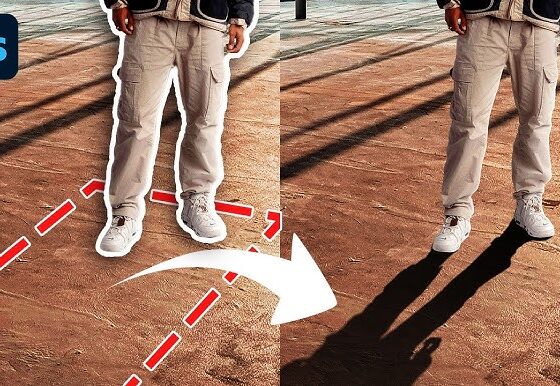
But basically what you need to know to render a decent shadow is quite simple things. First, shadows are never black. Unless of course the environment around your object is pure white and your object is black or white too. In any other case the shadow’s color is a composition of the environment’s dominant color and your object’s own color. How to apply this to our card?

Load the card as selection – Cmd+Click card’s vector mask in the Layers palette. Create a new layer Cmd+Shift+N and place it underneath the card layer. Now pick the color for our shadow – it should be something between the yellow (card) and green (background) - mine is #2E3B05. Fill selection with that color Option+Backspace:

teaser-tutorial-2-14.jpg

I turned the card layer off so that we could see our shadow. Now I turn it back on and use Free Transform to shape the shadow properly (rotate it, squeeze it and use Cmd+clicking the handles to shear-transform it):

teaser-tutorial-2-15.jpg

Step 5

Now the second principle of realistic shadows: The more is the distance from the object, the more blurry and transparent a shadow gets.

So we grab the Blur tool (keyboard R), with a radius of about 45-60 and start working on the upper (more distant) part of our shadow:

teaser-tutorial-2-16.jpg

Great, we made our shadow blurry, now it’s time to make it more transparent. Grab the Gradient Tool (keyboard G) and use the default black-to-white gradient.

Click the Add Layer Mask button while staying on the shadow layer. And now add some gradient to the mask, so that the blurred edge of the shadow becomes more transparent. Here’s the shot of my mask:

teaser-tutorial-2-17.jpg

Cool, now our card looks quite realistic and 3D!

teaser-tutorial-2-18.jpg

While our teaser looks almost finished, make sure you do not miss the 3rd final part of this tutorial, where I’ll tell you about the little things that make big difference!

Stay tuned and good luck with your designs! :)

Here are the links to all 3 parts of this tutorial:

Like this tutorial?

NobsTutorials.com is under construction, make sure you don’t miss the launch!

0 comments: